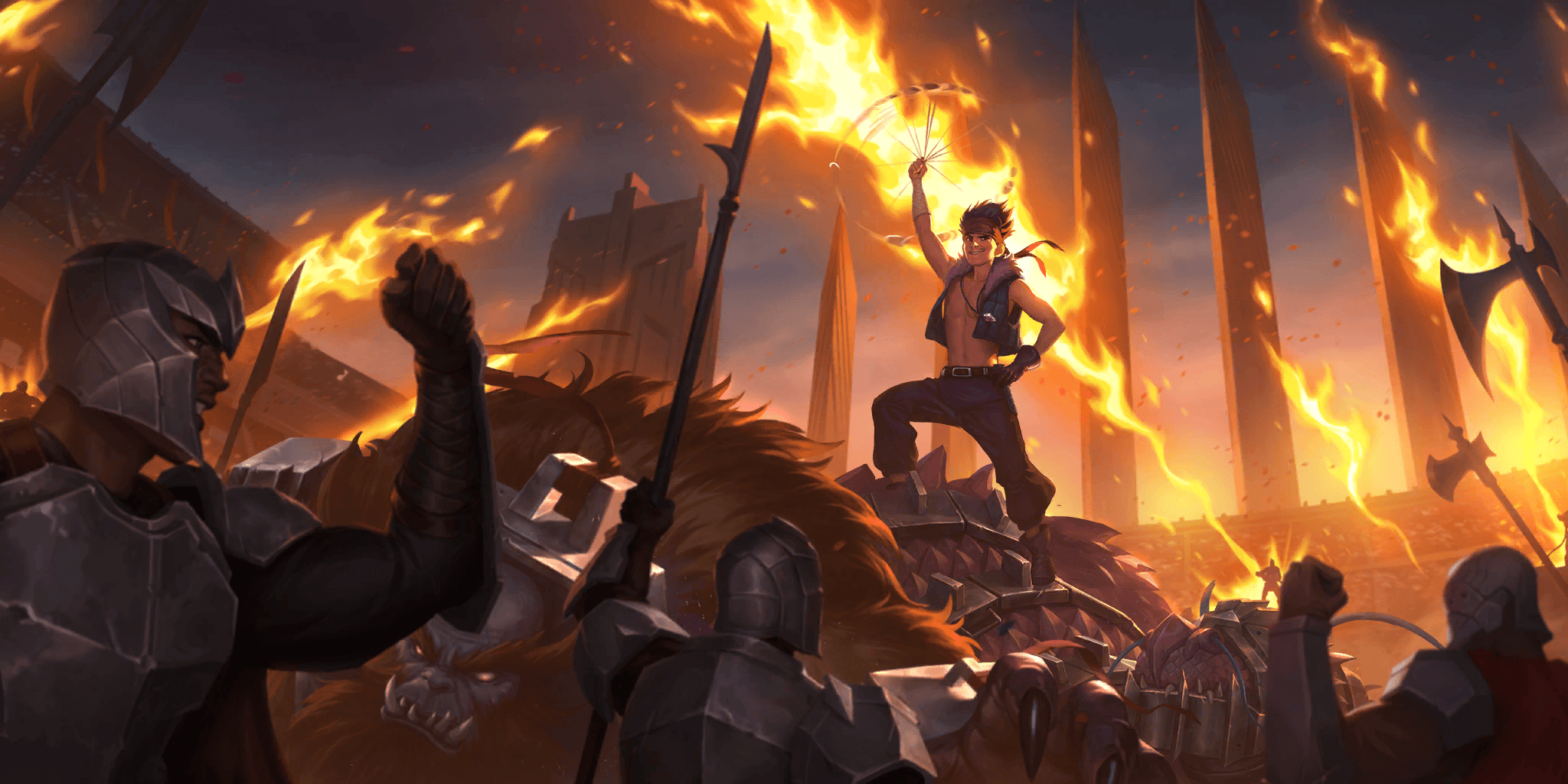
League of Legends, Valorant, Teamfight Tactics, Wild Rift, Legends of Runeterra and 2XKO all shipped with a ranked ladder. Riot has never released a game whose centre was not competition between players, and in June 2026 it hired, as the MMO's Principal Game Designer, a man whose first five years at Blizzard were spent running World of Warcraft's PvP.
Riot has said nothing about the MMO's PvP, before or after the 2024 reset. But the company's record and its hiring say more on this subject than on most, and the setting has opinions of its own. This is a survey of what an MMO can do with players fighting players, and which of those options fit both Runeterra and Riot.
What the hire says
Brian Holinka joined Blizzard in 2012 and, by the accounts collected when he moved to Riot, spent around five years as World of Warcraft's lead PvP designer before four more as its lead combat designer. PvP design in that game meant arenas, battlegrounds, rating systems, seasonal rewards and the permanent argument about whether abilities should behave the same against monsters and against people.
That is a specific expertise, and Riot did not need it to build dungeons. Whatever else the MMO is, the person shaping its combat has spent more time than almost anyone alive on the problem of making player-versus-player fair over years. We take up what that means for the combat model in what the Holinka hire tells us.
Model one: instanced and rated
Arenas and battlegrounds: small, fair, matched, ranked. World of Warcraft's approach, and the one closest to everything Riot has ever shipped. A ranked ladder with seasons is the company's native format, and it is the only PvP format that can plausibly support the esports apparatus Riot maintains for its other games.
The cost is that instanced PvP is a game inside the game. It gives the world nothing, and an MMO's world is the reason to make one rather than another arena title. Riot already has arena titles.
Model two: the open world at war
Factions, territory, sieges. The Elder Scrolls Online's Cyrodiil, where three alliances fight over one province; Guild Wars 2's World versus World, where whole servers contest maps for a week at a time; New World's company wars over settlements.
This is the model Runeterra was written for. Noxus and Demacia have been at war, cold or hot, for as long as the setting has existed. Noxus invaded Ionia within living memory. The Freljord's three tribes contest the north. Piltover and Zaun are one city with two governments. Bilgewater has no government at all. A game that let players stand on one side of any of those lines would need to invent nothing, and the invasion of Ionia in particular is the most usable two-sided conflict in the world, as the roster numbers in the 13 regions of Runeterra make plain.
The cost is the one every open-world PvP game pays: the player who wants to fish in Bilgewater and the player who wants to kill them are in the same place, and the game has to decide who wins. Greg Street's 2021 promise of an MMO that "respects the player's time" is hard to square with being ambushed on the way to a quest.
Model three: opt in
Flags, zones, servers. Most modern MMOs land here: PvP exists, it lives in marked places or behind a switch, and nobody meets it by accident. Final Fantasy XIV keeps it to a few modes; World of Warcraft moved to a toggle in 2018.
It is the compromise everyone reaches and nobody loves, and it is the likeliest baseline for any game launched after 2020.
Which fits Riot
Our reading, labelled as such. The spine will be instanced and rated, because that is what Riot is and what its new designer built: a seasonal ladder with the polish of League's ranked queue, probably with modes that borrow from League's own maps. Around it, opt-in open-world conflict along the borders the lore already draws, Noxus against Demacia first, because a Runeterra MMO with no war between those two would be leaving its best material unused. And no forced faction split at character creation, because a choice that locks a player out of half the world is the kind of genre convention the reset was meant to shed, and because Riot's audience picks a champion, not a side.
Esports at launch is unlikely. MMO PvP has resisted every attempt to make it a spectator sport, and Riot knows the difference between a format that films well and one that does not. The ladder will exist. The broadcast can wait.
The tension the hire does not resolve
Street promised a game that limits fear of missing out. Ranked seasons are engineered fear of missing out: rewards that expire, ratings that decay, a window that closes. Riot's other games run on that machinery, and it is the machinery Holinka spent five years building for Blizzard. Whether the MMO keeps Street's principle or Riot's habit is the question under every design decision on this project, and PvP is where the two meet most directly. We track the principle's survival in what is left of the 2021 vision.
What we do not know
Whether PvP exists at launch at all. Nothing has been said.
Whether factions are a mechanic or a backdrop.
Whether the MMO shares any infrastructure with League's ranked system, which would be the obvious way for Riot to ship a ladder quickly.
Whether "different enough", the reset's one stated goal, applies here. A PvP system that no existing MMO has would be a way to meet it, and Riot has the one designer best placed to know what has been tried. For everything the company has actually confirmed, see everything we actually know about the Riot MMO.