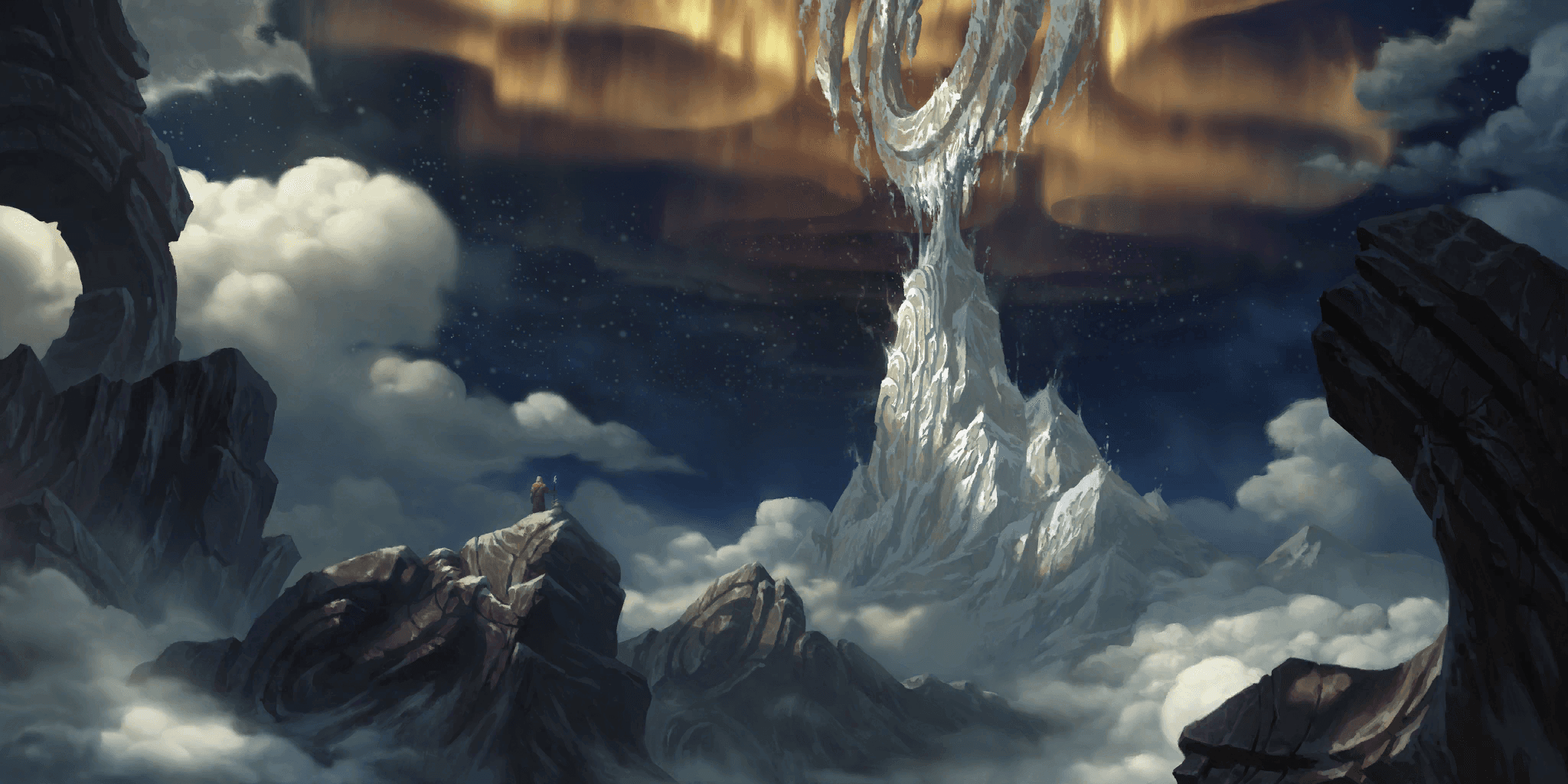
Runeterra is the planet on which League of Legends, Arcane, Legends of Runeterra and Riot's forthcoming MMO all take place. It has one large northern continent, Valoran, a southern continent, Shurima, and a scatter of islands between and around them, the two most important being Bilgewater and the Shadow Isles. Riot's official map divides the inhabited world into thirteen regions, and since 13 October 2023 every Riot story set there has shared a single canon.
That is the answer. The rest of this page is the context you need to read anything else on this site, in about ten minutes.
The name
The world takes its name from the World Runes: artefacts of raw creation, older than any nation, whose use in war roughly a thousand years ago came close to unmaking the planet. The conflicts are remembered as the Rune Wars. Their consequence is the setting's defining anxiety: most of Runeterra distrusts magic, and one nation, Demacia, was founded specifically to keep it out.
The mage Ryze has spent centuries collecting the surviving Runes so that nobody can use them again. His hunt is the only storyline that crosses every region, which is why it comes up so often when people speculate about what the MMO's main quest could be.
Two realms
Runeterra is not only the physical world. Alongside it lies the spirit realm, a plane of pure magic and living ideas that touches the material world unevenly. In Ionia the two bleed into each other, which is why the region's people, plants and animals are what they are. Bandle City, home of the Yordles, sits between the realms rather than in either. The creatures of Targon come from further out still.
Most of the setting's non-human peoples are explained by that boundary. The Vastaya are descendants of mortals who took spirit-realm magic into themselves. The Yordles are spirits who can take a physical form. The Void is not part of either realm; it is what existed before them, and it wants them gone.
The thirteen regions
From Riot's own overviews, in one line each.
Demacia: a lawful kingdom with a proud military history, built on the ideals of justice, honour and duty, and on petricite, a stone that drains magic. Its people prize order and have grown insular and suspicious of the sorcery their own laws persecute.
Noxus: an expansionist empire in which strength is the only qualification that matters. Anyone of any origin can rise in Noxus, and anyone who cannot is expected to serve those who can.
Ionia: the First Lands, an archipelago of natural balance and spiritual magic, invaded by Noxus within living memory and still divided over how to answer it.
The Freljord: a frozen north of hard tribes, three of which, under Ashe, Sejuani and Lissandra, contend for its future, above something ancient sealed beneath the ice.
Piltover: the City of Progress, a prosperous port of inventors and merchants, and the birthplace of hextech, which industrialised magic. Arcane's upper city.
Zaun: the undercity beneath and beside Piltover, choking, ingenious and ungoverned, where chemtech does what hextech will not. Arcane's lower city.
Shurima: a southern desert holding the ruins of an empire that fell under its own Sun Disc, the artefact that made its rulers into god-warriors called the Ascended. The empire's founder, Azir, has recently returned.
Targon: a mountain whose summit few reach and fewer return from, where celestial beings called Aspects choose mortal hosts.
Ixtal: a jungle nation sealed off since the Rune Wars, keeper of the oldest elemental magic on the continent.
Bilgewater: a port of pirates, sea monsters and hard bargains, with no law but what the powerful enforce.
The Shadow Isles: once the Blessed Isles, a centre of learning, until a king's grief brought the Ruination and the Black Mist that has covered them since.
Bandle City: the Yordles' home, a place between realms that appears to mortals only when it chooses.
The Void: not a place on the map but a threat to all of them. Icathia, a Shuriman province, opened a door to it in rebellion and was the first thing it consumed.
Riot's map also names smaller places without their own region, among them Camavor, the vanished homeland of the king who caused the Ruination, and Kathkan, which almost nothing has been written about. Both were mentioned in early coverage of the MMO's scope.
The four events
Nearly every story in the setting stands on one of four moments.
The fall of Icathia, when a rebellion against Shurima summoned the Void and lost. This is where the Void enters the world and where Shurima's decline begins.
The Rune Wars, when the World Runes were used as weapons and the world nearly ended. This is why Demacia exists, why Ixtal sealed itself, and why Ryze is still walking.
The Ruination, when the king of Camavor, Viego, tried to bring his wife back from the dead and turned the Blessed Isles into the Shadow Isles. This is the source of the Black Mist and of most of the setting's undead.
The Noxian invasion of Ionia, the one contemporary war, which broke Ionia's peace and produced a generation of its champions.
If you learn the outline of those four, most biographies will make sense on first reading.
What lives here
League of Legends supplies the cast: 173 champions as of June 2026, each with a published biography on Riot's Universe site, and each tied to a region, or in a few cases to none. Ionia has the most, at twenty-three, then Noxus and Demacia.
Arcane supplies the most detailed picture of any single region, Piltover and Zaun, across two seasons. Legends of Runeterra, a card game now reduced to its single-player mode, supplies more than two thousand illustrations that are the best visual record of the other eleven. A novel, Ruination, and a handful of comics and Riot Forge games fill in specific corners.
A reading order through all of it is in where to start with Runeterra, from zero.
What the MMO has to respect
Riot unified the canon on 13 October 2023, the year before it reset the MMO. The effect is that the game will be built inside a continuity it does not control alone: what Arcane has shown of Piltover, Zaun and their people is fixed, and what the MMO shows must fit. The pre-reset plan named nearly all of the thirteen regions as places the game would eventually cover; whether that survived the reset has not been said. Which of Runeterra's peoples a player could be is the first place the lore starts making decisions for the designers, and we work through it in playable races.
The one thing the setting does not have is a fixed present. Riot has never placed the MMO on Runeterra's timeline, and the answer decides which of the 173 champions can be alive when you arrive. It is on the list of unknowns in everything we actually know about the Riot MMO, and it is the one we would most like answered.