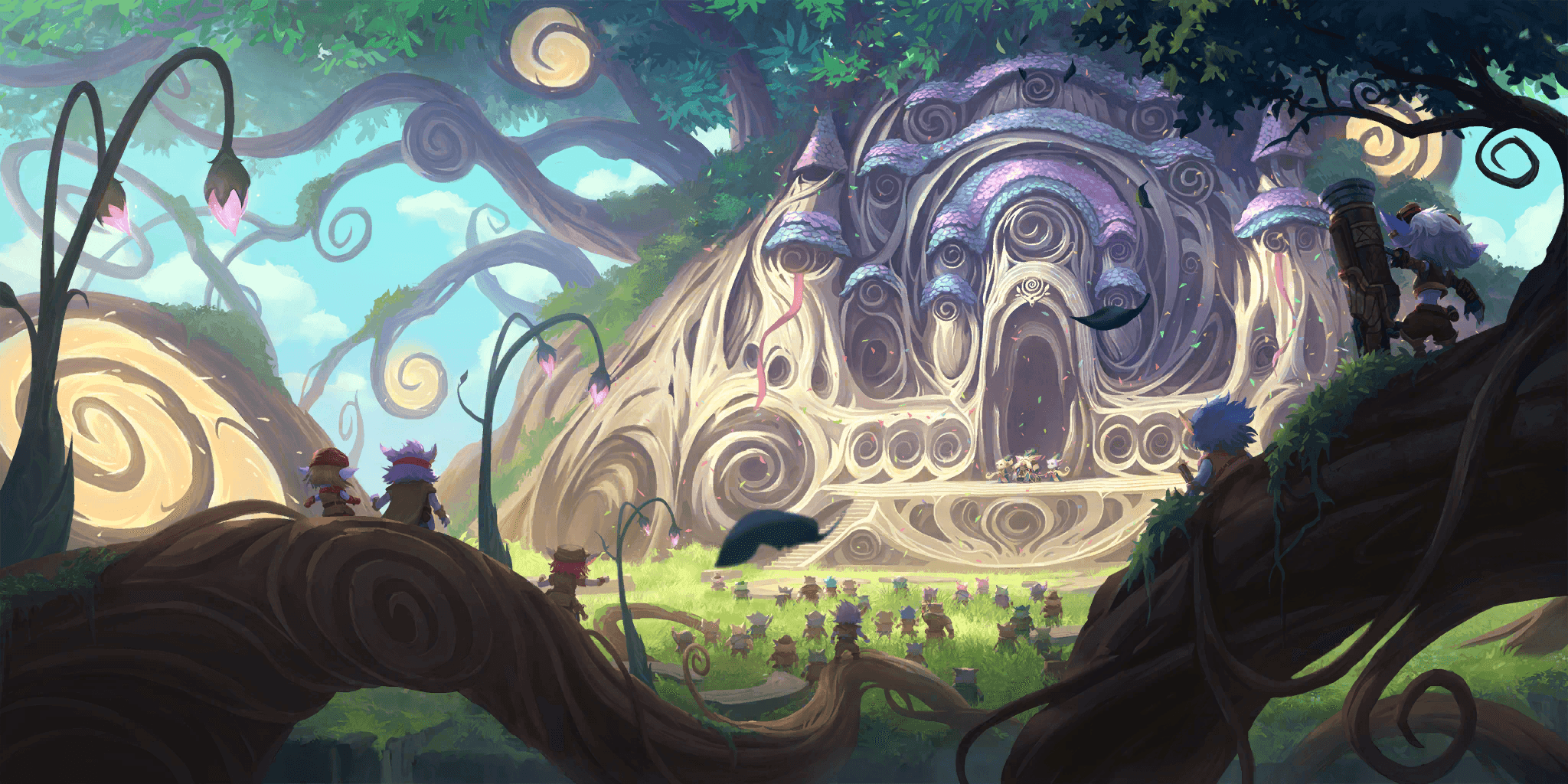
Riot's world has 173 champions with published biographies, thirteen mapped regions, one novel that runs 400 pages, two seasons of an animated series, a shelf of comics, several hundred short stories and a card game with more than two thousand illustrations. None of it comes with a reading order, because none of it was written as one. Runeterra is an anthology, not a saga.
That is the thing to understand before you open anything. There is no book one. There are entry points, and some are much better than others. This is the order we give people who ask, with the time each step costs and the reason it comes where it does.
The order, in one paragraph
Watch Arcane. Open the interactive map and read the region overviews for the places Arcane showed you. Read the biographies of the champions you met there, then the ones you are curious about. Read five short stories. Read Ruination. Play Path of Champions in Legends of Runeterra if you want the art, and Ruined King if you want the world in three dimensions. Save the comics and the other games for when you have a favourite region. Skip the alternate universes entirely until you know what the main one looks like.
About forty hours if you do all of it, and you can stop after any step.
Step one: Arcane
Two seasons, eighteen episodes, on Netflix. Season one arrived in November 2021 and season two in November 2024.
Arcane is the right start for three reasons. It is the best-made thing in the setting by a wide margin. It needs no prior knowledge and explains nothing it does not need to. And since 13 October 2023 it is canon: Riot unified the series, Legends of Runeterra and the forthcoming MMO into a single continuity, which means what you see in Arcane is what the MMO will have to respect.
What it will not give you is breadth. Arcane is about two cities, Piltover and Zaun, and a handful of people in them. Thirteen regions exist. You have seen one and a half.
Step two: the map
Riot's interactive map at map.leagueoflegends.com is the single most useful page in the setting and the least visited. Click a region and it gives you the overview, the governance, the attitude to magic, the level of technology, the champions who live there and the stories set there.
Read Piltover and Zaun first, because you know them now. Then Demacia and Noxus, the two powers that shape most of the continent's politics. Then Ionia, which Noxus invaded, and Shurima, which is a buried empire coming back. Then the rest in whatever order the pictures pull you. Each overview takes ten minutes.
Do this before the biographies, not after. A champion's story is a scene; the region is the set.
Step three: biographies
Every champion has one on Universe, at universe.leagueoflegends.com, in two lengths: a paragraph and a full page. Read the full pages.
Start with the Arcane cast, because you will notice where the series and the biographies differ, and that difference is a useful lesson about how Riot treats canon. Then read by region. The Demacia and Noxus rosters together are about thirty champions and will teach you the two ideologies that most of the continent's conflicts run on. The Ionia roster, the largest at twenty-three, will teach you what the Noxian invasion did.
Some biographies are stories in themselves. Kindred's is a myth. Bard's is a shrug. Jhin's is a confession. Budget an evening for the first dozen; you will not stop at a dozen.
Step four: five short stories
Universe hosts several hundred short stories, and Riot published them without an index that says which ones matter. Five that do, in the order to read them, each verified as still online:
"Where Icathia Once Stood", told by a soldier of Icathia, for the war against Shurima and the day the Void was let in. "The Eye in the Abyss", for the Freljord, its Frostguard, and what waits under the ice. "Shield of Remembrance", a Quinn story, for how Demacia's borders are held and by whom. "The Shackles of Belief", an Illaoi story, for Bilgewater's tone and its gods. "The Echoes Left Behind", for the Shadow Isles and the man who made them, as a run-up to the novel.
Each is under half an hour. Between them they cover five regions and two of the four events on which nearly everything else in the setting depends: the fall of Icathia and the Ruination. The other two, the Rune Wars and the invasion of Ionia, are better met in the region overviews and the Ionian biographies.
Step five: Ruination
Ruination: A League of Legends Novel, by Anthony Reynolds, published on 6 September 2022, with a collector's edition in December 2023 that adds a chapter set after the ending.
It is the one long-form, canonical account of the Ruination, the event that turned the Blessed Isles into the Shadow Isles and produced a third of the setting's villains. It is told from the perspectives of Kalista, Thresh and Ryze, which makes it an introduction to Ryze as well, whose hunt for the World Runes is the only story that crosses every region.
Read it after the short stories and after the Shadow Isles overview, or the names will slide past you. It is the point in this order where the world stops being a set of postcards and starts being connected.
Step six: play something
Two options, for two kinds of curiosity.
If you want the art, Legends of Runeterra's Path of Champions is a single-player mode that still runs, and it is the reason the card game's 2,136 illustrations exist. Riot reduced the game to that mode with a smaller team; the pictures did not get smaller. Playing through a few champions' paths is the fastest way to see what each region looks like when someone has painted it properly.
If you want the world in three dimensions, Ruined King: A League of Legends Story, published in 2021 under the Riot Forge label, is a turn-based RPG set in Bilgewater and the Shadow Isles with Miss Fortune, Illaoi, Braum, Yasuo, Ahri and Pyke as the party. It remains the nearest thing to a Runeterra MMO that anyone has shipped, which is why we come back to it in everything we actually know about the Riot MMO.
Riot Forge closed in January 2024. The games are still sold.
Later: comics and the other games
Marvel and Riot published three comic series between 2018 and 2020: Ashe: Warmother, Lux and Zed. They are good and they are regional. Read Ashe when you care about the Freljord, Lux when you care about Demacia's persecution of mages, Zed when you care about Ionia's shadow order. Not before.
The other Riot Forge games follow the same rule. Song of Nunu is the Freljord. The Mageseeker is Demacia. Convergence is Zaun before Arcane rewrote it. Bandle Tale is the Yordles. Hextech Mayhem is a rhythm game and not required reading. Each is a region-length commitment and each rewards knowing the region first.
What to skip until later
Anything labelled Star Guardian, PROJECT, Odyssey, K/DA, Pentakill, Heartsteel or Battle Academia. These are alternate universes, produced for skins and music, and Riot is explicit that they sit outside the main canon. They are also where a lot of League's most visible art lives, which is why newcomers get lost in them. Come back once you know what the primary world looks like, and they become a pleasure rather than a confusion.
Also skip anything that mentions the Institute of War or "summoners" as characters. That was League's original framing, retired in 2014, and a great deal of older fan material still uses it.
How canon works here
Two rules will save you time. Universe is the source of truth: when a wiki, a video or a comic contradicts it, Universe wins. And Riot revises. The unified canon of October 2023 is the current state, and it changed things that were true in 2019, which is part of why the MMO's own place on the timeline matters so much and is still unannounced.
If you want the world at the level below all of this, the one-page version is what is Runeterra?. If you want to know what any of it has to do with a game that does not exist yet, the answer is playable races, which is the first place the lore starts making design decisions for Riot.