League of Legends has 173 champions, and every one of them has a published biography with a name, a home, a history and, for several, a death. A player in Riot's MMO will be the 174th person in that world, and Riot has not said whether that person is Garen, someone who takes orders from Garen, or someone who kills him.
Nothing below is confirmed. Riot has said nothing about the player's relationship to the champions, before or after the 2024 reset. What follows are the three models an MMO can use when its setting already has a cast, the precedent for each, and the reasons the lore itself pushes toward one of them. We say which, and we label it a reading.
Why this is the hardest decision on the project
Most MMOs invent their world and their heroes together, so the player can be the hero without contradicting anyone. Runeterra arrived with its heroes already drawn, voiced, and, since Arcane, filmed. Whatever Riot decides, a hundred million people already have a favourite champion, and the game has to answer, at the character-creation screen, what that favourite is to them now.
The unified canon makes it harder. On 13 October 2023 Riot placed Arcane, Legends of Runeterra and the MMO in one continuity. That fixes what the champions have done and, in several cases, whether they are still alive. A game cannot let ten thousand players be Viktor if Viktor's story has an ending Netflix has already broadcast.
Model one: you are a champion
The precedent is Marvel Heroes, which ran from 2013 to 2017 and let every player be Wolverine at once, with the fiction shrugging at the result. It was a good action game and a poor world, and it closed.
Riot has reasons to be tempted. Its entire business is built on people choosing a champion, and the identity that comes with that choice is why skins sell. A Runeterra MMO in which you pick Ahri and level her up would convert League's audience with no friction at all.
It also breaks nearly everything an MMO is for. Progression means becoming someone; a champion already is someone. Group content means roles; a roster of 173 fixed characters is a balance problem Riot already has, transplanted into a genre where it costs more. And the lore forbids it outright for the characters people most want: there are five Darkin in the canon, not five thousand, and we set out why that rules them out even as a race in playable races.
Our reading: not at launch, and not as the core. If champions are playable anywhere, it will be in a bounded mode, the way League's own game modes let you be the character for twenty minutes.
Model two: champions as the people you meet
The precedent is most of the genre. In World of Warcraft you stand beside Thrall and Jaina; in Final Fantasy XIV the Scions do the talking and you do the fighting; in The Lord of the Rings Online you are nobody the Fellowship has heard of, and the game is better for it.
This is the model the lore is written for. Riot's biographies are structured as scenes: a character, a place, a problem. Each one is a quest hub waiting to be built. Ionia has twenty-three champions and a war to recover from; Demacia has sixteen and a persecution to reckon with; Noxus has seventeen and an empire to run. The regions are the zones, the champions are their inhabitants, and a player who is not a champion can move through all of it without breaking any of it.
The cost is emotional rather than mechanical. A player who came for Jinx and is told to fetch her something may feel demoted. Riot knows this audience better than anyone, and it is the reason we do not think model two arrives on its own.
Model three: champions as the things you fight
The precedent is Arthas, Deathwing and every expansion boss since. Runeterra's antagonists are already designed for it: the Darkin, the Void's hierarchy, Viego and the court of the Shadow Isles, the Watchers under the Freljord's ice, Xerath under Shurima's sand. Greg Street said in 2021 that the game would have complex bosses, and floated Baron Nashor, which is a way of saying the bosses will be creatures you already know.
Model three is not a rival to model two; it is the other half of it. The champions you meet in the capital are the ones you fight in the ruins. The only question is how far Riot lets it go: whether a raid can end with a champion dead, and whether the canon bends to let it.
The summoner problem, and why it matters here
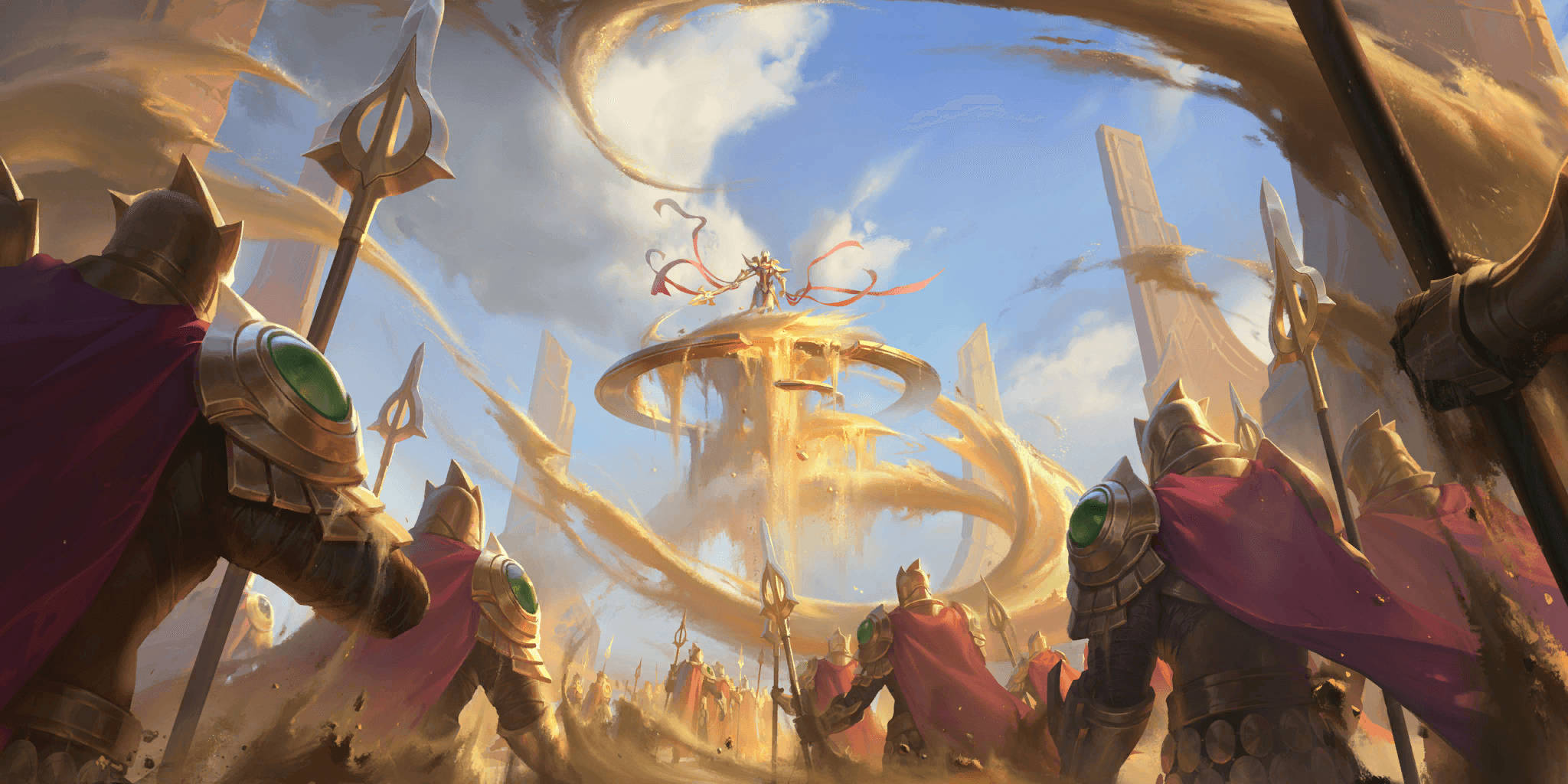
League's original fiction had an answer to all of this. Players were summoners, magi who controlled champions in ritual battles at a place called the Institute of War. Riot removed that framing in 2014, and has spent twelve years building a world in which champions act for themselves.
That retcon is the reason the question is open. The old fiction gave the player a role next to the champions; the new fiction has not replaced it. Whatever the MMO decides, it has to invent a place for the player that League itself no longer has, and that invention is where Merrill's "different enough" could most plausibly live. An MMO that solved the relationship between an ordinary player and an existing pantheon in a new way would be different from what exists. None of the three models above is new. A fourth might be.
The era decides the cast
One decision sits under all three models, and Riot has not made it in public: when the game is set. Contemporary with Arcane, some champions are children and others are dead. A century earlier or later, the roster changes entirely. The choice of era decides which of the 173 can be met, fought or, in a bounded mode, played, and it is the unknown we would most like answered, as we say in everything we actually know about the Riot MMO.
Our reading, labelled
Player-created characters, drawn from the peoples and regions of Runeterra. Champions as the inhabitants of those regions and the bosses at the end of them. A limited way to stand in a champion's shoes, in a mode rather than in the world, because Riot will not leave its own identity system unused. And, somewhere in that arrangement, a role for the player that the current lore does not yet contain.
That is a reading of the lore and of Riot's incentives, not of anything Riot has said. What it has said, on this and on everything else, is collected on the page above; what it threw away in 2024 is in the 2024 reset, explained; and the world all of this happens in is in what is Runeterra?