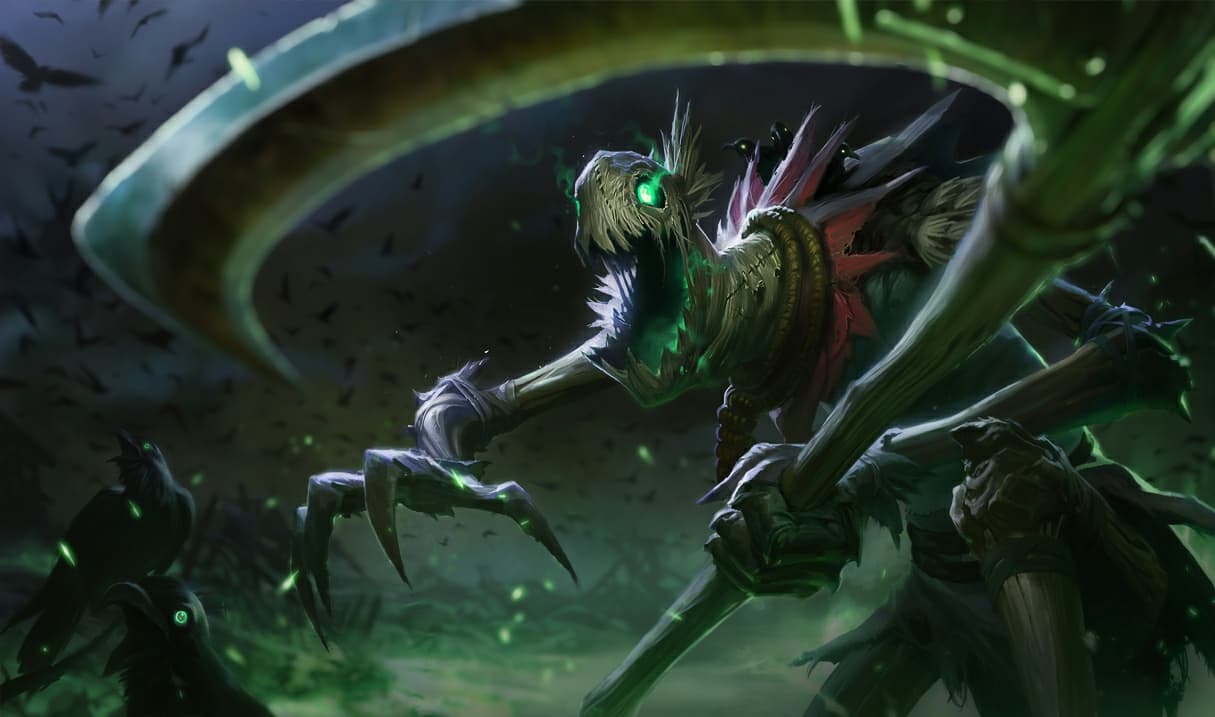
"Something has awoken in the Demacian hinterlands, drawn by the climate of rising fear and paranoia." Riot's biography of the Ancient Fear spends its first half on stories and its second on that sentence: rural protectorates emptying in days, travellers vanishing from the old footpaths, patrols not reporting back, and survivors in roadside taverns clawing at their faces. Every region of Runeterra has a version of the scarecrow story. The text's claim is that one of them is now true.
Who they are
Long ago, in a tower by the sea, a foolish young mage summoned something he could not control, something older than recorded history and darker than a starless night, and in an instant the mage, the creature and the tower were lost to time. At least, the biography says, that is what the stories say. It then lists the others. Freljordian children scare each other with a monster that rises from untended graves in the ice, a shambling mass of helmets, bucklers, furs and wood. Bilgewater's sailors trade accounts of something standing on a distant atoll from which nobody returns. A Targonian legend has a child of twilight steal the only joy from a ragged, whispering horror. Noxian veterans tell of a farmhand blamed for a bad harvest, fed to the crows and returned as a demon. Demacia, Ixtal, Piltover, Ionia, Shurima: everywhere, a thing that looks almost human and stalks places thick with fear, and nobody afraid of a silly old monster called Fiddlesticks.
Until now. In the Demacian hinterlands, hundreds of miles of farmland from the capital, the survivors speak of crows that are not crows, sounds that are not sounds, and a lopsided horror in the shape of a scarecrow that croaks in the stolen voices of the dead. Most blame rogue mages, which the text notes is a common accusation in these days of rebellion. The truth, it says, is worse: something has returned, just as in the tale of the mage in the tower. An evil gone from the world for so many centuries that the warnings of an early humanity decayed into rumour, then myth, then legend, then fable. An entity so alien it defies almost all contemporary knowledge of magic, so ancient it has always been, so universally feared that animals grow nervous at its name.
One more tale has resurfaced with it, nearly lost: a great evil with no form, no thoughts and no understanding of the world, that builds itself into the crude shape of whatever fears it. The terror of all living things, given life in the first scream of creation. A demon before demons were known. At least, that is what the stories say. The biography's last line is that Fiddlesticks is real.
Where they belong
Riot's faction pages give Fiddlesticks no region. The biography places its current activity in the hinterlands of Demacia, and its legends everywhere else.
Riot's page lists no race. The text's words are demon, entity, and thing.
Riot lists two related champions:
- Nocturne: not named in Fiddlesticks's biography.
- Shaco: not named either. The biography names no individual at all, which suits a creature that builds itself from other people's fear.
In the Riot MMO, as a guess
This is speculation. Fiddlesticks is a boss, and the lore hands a designer both the setting and the rule: a Demacian countryside emptying of people, and a creature that takes the shape of what its victims fear, which is an encounter that can look different to every player and a horror the game can seed with rumours long before it appears. It is not a quest-giver in any sense; it has, the text says, no thoughts. And it may be the best argument in the roster for a game that treats fear as a mechanic rather than a status effect, since the biography is explicit that this is what it feeds on. Whether any champion is playable is the question in will champions be playable; the Ancient Fear is not a candidate.
What we do not know
Whether the game's era, the open question in when is the Riot MMO set?, comes before or after it woke. The text says numberless centuries of absence and then "until now", with no date attached; a creature that has always been does not die.
What woke it. The biography says rising fear and paranoia in Demacia, and does not say why they were rising.