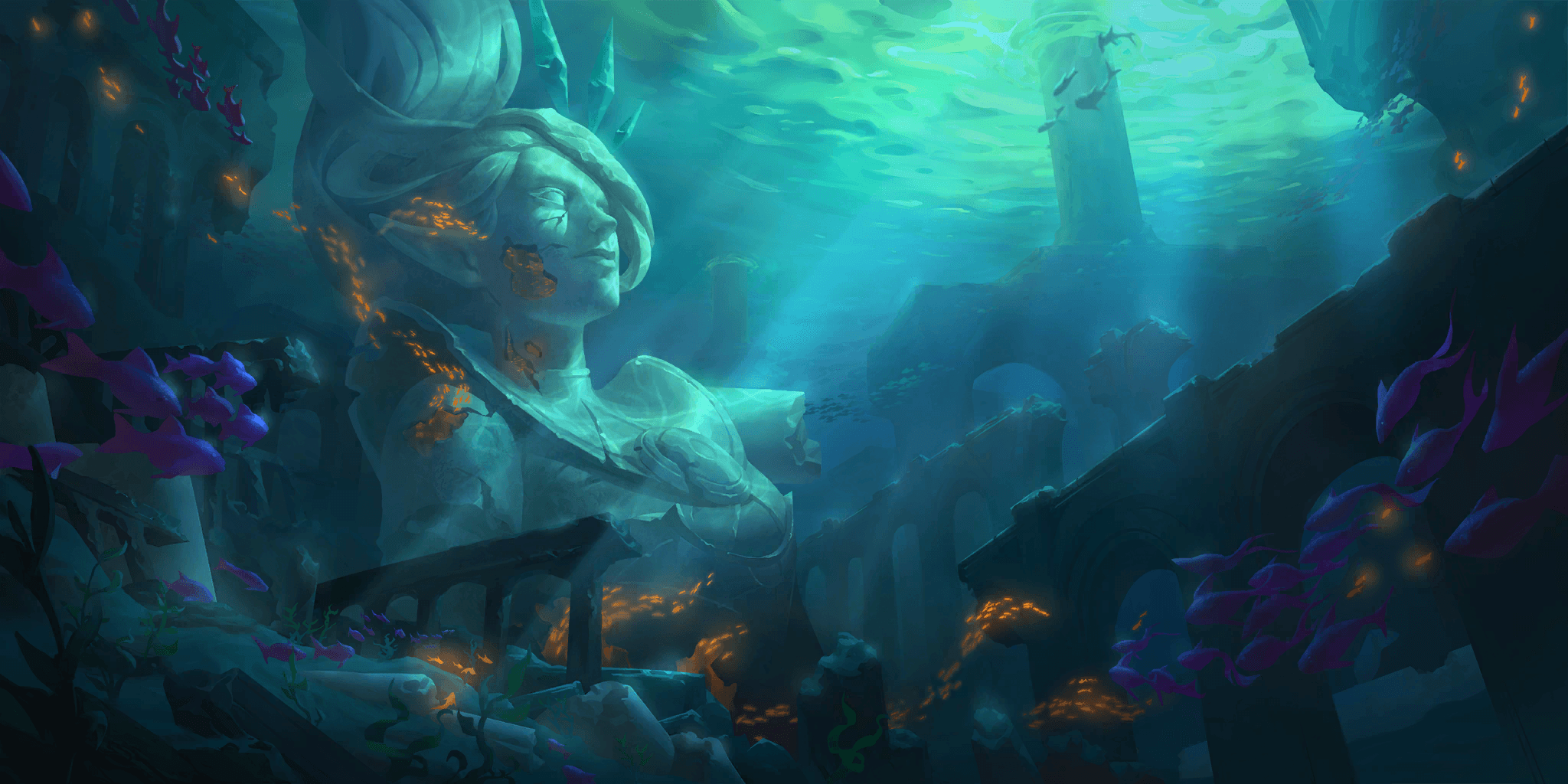
Viego is awake. Azir has returned. Senna died and came back. Jinx has done what Jinx did in Arcane. Every one of those is a fixed point in Runeterra's timeline, and every one of them is either before, during or after the moment the Riot MMO will drop a player into the world. Riot has never said which.
That single unannounced decision does more to shape the game than any class list or combat model, because it decides who is alive when you arrive. This is a survey of the options, what each costs, and how the three most comparable licensed MMOs made the same choice.
The problem with "now"
Runeterra has no calendar. Riot has never dated its world, and the champion biographies on Universe are written in a continuous present in which everyone's story is happening at once. That is fine for a card game. An MMO has to pick a moment and hold it for a decade, and the moment fixes the cast.
The unified canon makes the choice binding. Since 13 October 2023, Arcane, Legends of Runeterra and the MMO share one continuity. Arcane runs across roughly a decade in Piltover and Zaun and ends with its characters in specific places, some of them dead. A game set during Arcane cannot contradict it; a game set after it inherits its ending; a game set before it cannot show what has not happened yet. We set out what the canon fixes in what is Runeterra?.
Option one: the present, alongside the champions
The game is set at the moment the biographies describe, and the champions are where their stories left them. This is the option that uses the most of Riot's material: 173 characters, each in the place and situation a hundred million players already know, ready to be met or fought.
Its precedent is The Lord of the Rings Online, which is set during the War of the Ring and lets the player move through Middle-earth beside the Fellowship without ever being one of them. It has run since 2007 on that arrangement.
Its cost is that "the present" in Runeterra is not one time. Arcane's present, League's present and Legends of Runeterra's present were reconciled only in 2023 and imperfectly. A game set "now" has to decide, character by character, which now.
Option two: the past
The game is set in an era before the champions, or before most of them. The Rune Wars, a thousand years back, when the World Runes were used as weapons and the world nearly ended. Or Shurima at its height, when the Sun Disc still made gods and Icathia had not yet opened the Void.
Its precedent is Star Wars: The Old Republic, which BioWare set more than three thousand years before the films precisely so that the canon could not touch it, and The Elder Scrolls Online, set a thousand years before Skyrim for the same reason.
Its appeal is freedom: Riot could show the Ruination, the Ascension, the Rune Wars themselves, events the biographies only refer back to, with no living champion's story to protect. Its cost is the whole point of the licence. An MMO in which Garen, Jinx and Ahri have not been born is an MMO that cannot sell them, and Riot's business is selling them. BioWare could afford to lose Luke Skywalker. Riot's executive producer, Fabrice Condominas, came from BioWare, the studio that made that game; he will know exactly what the trade was.
Option three: the future
The game is set after every current story has ended, which frees the designers from Arcane's ending by making it history and lets the champions age, die or change. Nobody has done this with a licence of comparable size, because nobody wants to be the MMO that tells players their favourite character died off-screen.
What the reset might have changed
Before 2024, coverage of the game listed nearly every region as a destination and treated the champions as inhabitants, which is consistent only with option one. The reset threw out a design that was "not different enough", and the era is one of the few places where a difference could be made cheaply: a Runeterra MMO set during the Rune Wars would be unlike anything Riot has shipped, and unlike anything the audience expects.
We do not think that happened. The hires since 2024 are production and combat people, not writers, and the company's silence covers the setting along with everything else. But it is the reason the question stays open rather than assumed.
Our reading, labelled
Option one, in a "now" placed shortly after the end of Arcane's second season: late enough that the series is history the game can reference, early enough that the roster is intact. That fits the canon Riot built in 2023, the pre-reset design as described, and the business. It is also the option with the most constraints, which is a reason to think Riot's writers have been busy for two years in a way nobody has seen.
The consequences of the choice run through everything else on this site. It decides whether champions are met, fought or absent, the question we take up in will champions be playable, NPCs, or bosses?, and it is the first unknown listed in everything we actually know about the Riot MMO.
What we do not know
Whether Riot has decided, or whether the era is part of what the silence is protecting.
Whether the MMO's writers are the same team that reconciled the canon in 2023.
Whether Arcane's next projects, which Riot has said it wants, will move the present further before the MMO arrives, and whether the game has to wait for them.
Whether any champion will die in the MMO. It sounds like a detail. It is the whole question, stated small.