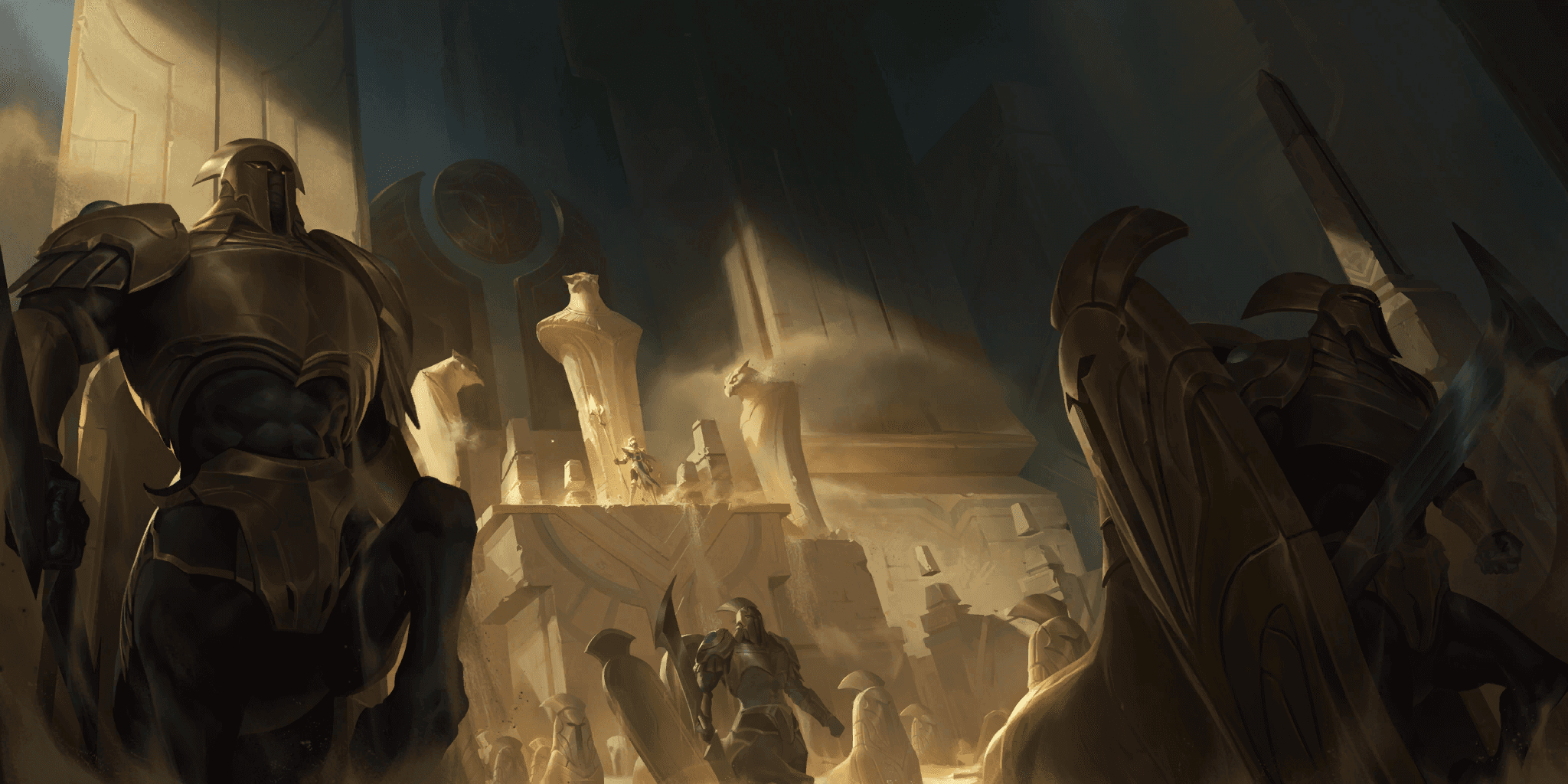
Baron Nashor has been killed several billion times. He is the most fought boss in the history of video games, and in 2021 Greg Street, then leading the Riot MMO, mentioned him as the kind of creature players could expect to face together. That is the only named boss in the project's public record, and it was an example rather than a plan.
Raids are the part of the pre-reset vision with the most evidence for survival and the least evidence of shape. This article sets out what was said, what the hiring since implies, and what Runeterra hands the encounter designers before they draw a single arena.
What was said
Street's interviews and developer answers in 2021 and 2022 made group content a priority: dungeons, raids, and fights against "complex" bosses that would take coordination to beat. The Baron Nashor remark travelled because it was concrete, and it said something specific: the bosses would be things the audience already knows. Reports from the period also listed dungeons alongside housing and fishing as intended features.
All of that predates the March 2024 reset, and none of it has been reconfirmed. It sits on the scorecard in what is left of the 2021 vision as "probable", which is higher than most of its neighbours, for the reasons below.
What the hires say
Riot's three World of Warcraft hires since 2024 cover engineering, production and combat. Raiding is the discipline Blizzard invented in its modern form, and Brian Holinka, who joined as Principal Game Designer in June 2026, spent four years as that game's lead combat designer, which in World of Warcraft means designing abilities with raid encounters as the primary test.
A studio does not hire that expertise for a game without large group PvE. The reset threw out a design that was "not different enough"; group bosses were not the sameness Marc Merrill objected to, because every MMO's players want them and no MMO has yet found a replacement.
There is a wrinkle, and it is the same one that runs through the combat question. Raids are the content that most rewards tab-target legibility: forty people can read a fight when the system, not their aim, resolves it. The pre-reset promise was action combat. If both survive, the MMO's encounter designers are solving a problem the genre has only half solved, which is exactly the problem Holinka was hired to solve. That argument is in what the Holinka hire tells us.
What Riot already knows
The company has never shipped an MMO raid. It has shipped a great many boss fights.
League's own map has Baron, the Dragons, the Rift Herald and, since 2024, Atakhan: bosses fought by five players with timers, positioning and punishment for mistakes, tuned across thousands of competitive matches. League's PvE modes, from the Star Guardian invasion of 2017 through Odyssey in 2018 to Swarm in 2024, were experiments in cooperative boss encounters using League's champions and cameras. None of it is a raid. All of it is the raw material for one, and Riot's encounter designers have more data on how five people fight a monster than any studio in the genre.
What the setting supplies
Runeterra's antagonists are pre-built for the role, and most of them are creatures a player would recognise from the first screenshot.
The Void supplies a hierarchy: Baron Nashor is Void-born, and above him stand Vel'Koz, Cho'Gath, Bel'Veth and, at the top of the biography, the Watchers under the Freljord's ice. The Darkin supply five named weapons with gods inside them, and we argue in playable races that they are the best boss material in the setting precisely because they can never be playable. Shurima supplies Xerath and the buried Sun Disc. The Shadow Isles supply Viego, Thresh, Hecarim and the whole court of the Ruined King, in a place whose entire purpose in the lore is to be the region nobody survives.
An encounter designer given that list is not short of bosses. They are short of decisions about which champions a raid is allowed to kill, which is the question we take up in will champions be playable, NPCs, or bosses?
Shape, as a guess
Labelled as speculation. Group sizes in the genre have settled small: eight in Final Fantasy XIV, ten in Guild Wars 2, and flexible groups in World of Warcraft that scale between ten and thirty. A Riot MMO built by people who spent a decade on the last of those will not launch with forty-player content. Five, League's own number, is the obvious base unit, with raids assembled from two or three of them.
The bosses will be known names, because Street said so and because it is why anyone would raid in Runeterra. And the difference the reset demands, if it applies here at all, is likelier to be in where fights happen than in how: world bosses in the open, in the manner of Guild Wars 2, fit an MMO that wants players to see its regions rather than queue past them.
What we do not know
Whether raids exist at launch, or arrive later, as they did for most of the genre's recent entries.
Whether any champion can die at the end of one, and whether the unified canon of 2023 allows it.
Whether the combat model settled after the reset is one that makes large groups readable.
Whether "complex bosses" in Street's sense survived the reset, or were among the things it reset. Everything Riot has confirmed on the subject, which is nothing since 2024, is in everything we actually know about the Riot MMO.