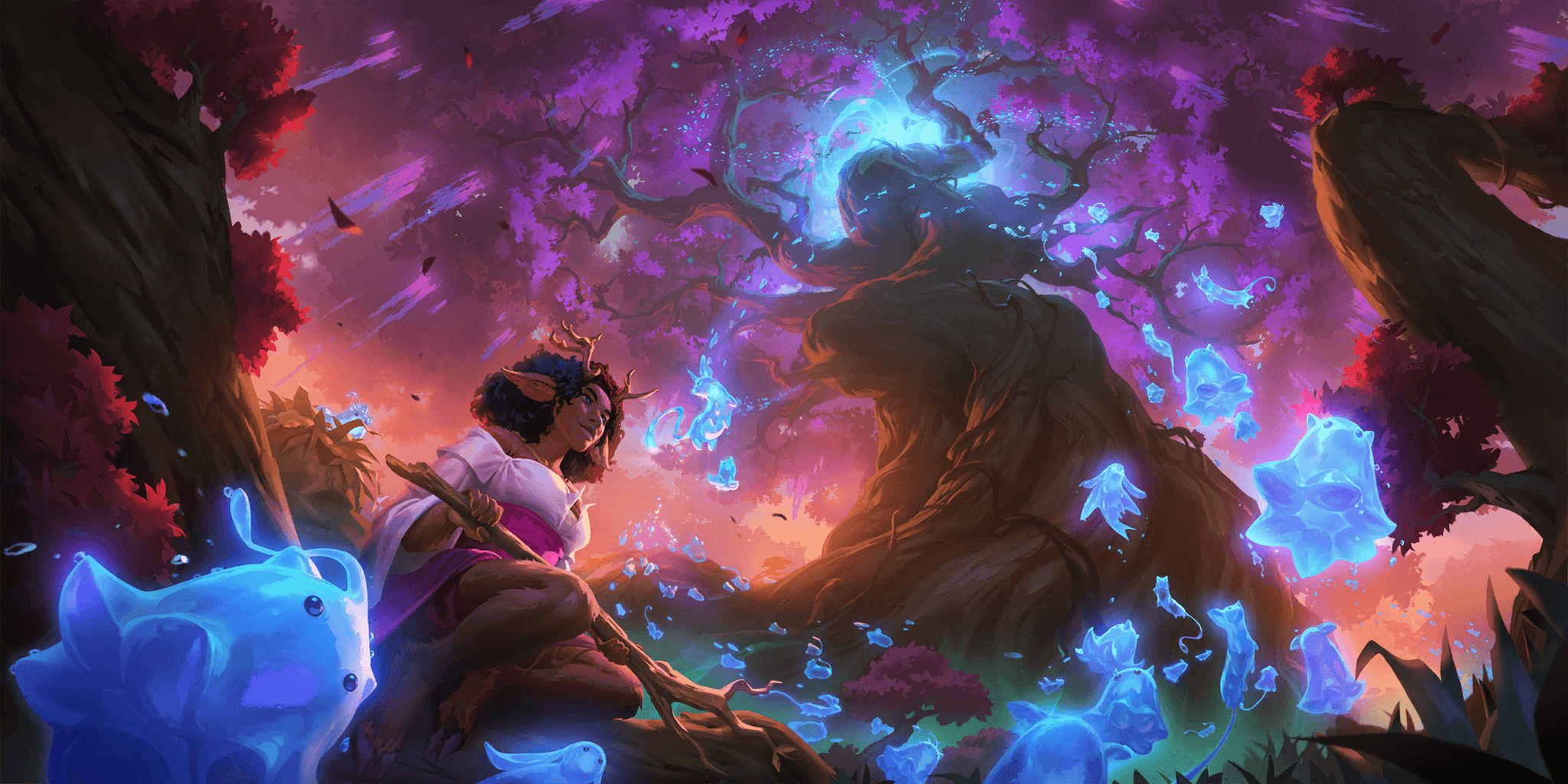
Ionia has twenty-three champions on Riot's faction page, more than any other region, and Noxus, which invaded it, has seventeen. Between them the two hold nearly a quarter of League's roster, and the war between them is the only conflict in Runeterra that a hundred million players already know the sides of.
This is the hub for Ionia: what Riot's own material says it is, who lives there, the war that defines its present, and what all of that would be in the Riot MMO. Everything about the game is speculation, labelled; everything about the region comes from Riot's Universe pages.
What Ionia is
Riot's overview calls it the First Lands: a large archipelago east of Valoran, across a sea, made up of allied provinces rather than a single state. Its culture, in Riot's phrase, has "long been shaped by the pursuit of balance in all things", and that pursuit has a physical consequence. The border between the material world and the spirit realm is thinner in Ionia than anywhere else, thinnest of all in its wild forests and mountains, so that the land's magic, creatures and even its trees behave as though they were half-alive with something else.
For most of its history that made Ionia a place of plenty, defended by warrior monasteries and provincial militias and by the land itself, which has a way of turning on invaders. Then an invader came who did not care.
The war
Noxus landed on Ionia within the lifetimes of most of its champions. The invasion was fought across the archipelago, its worst moment the use of Zaunite chemical weapons against Ionian towns, and its turning point the stand at the Placidium of Navori, where Irelia's resistance held. Noxus withdrew. Ionia did not recover.
What it did instead was split. Some Ionians, Karma among them, hold to the old balance and the belief that the land will heal if left alone. Others, Irelia's followers, keep the militia that won the war and expect to need it again. Zed's Order of Shadow took the harder lesson, that balance lost the first years of the war and force ended it, and broke from the Kinkou Order that Shen still leads. Yasuo was blamed for a death in the war and exiled; Yone, his brother, died pursuing him and came back changed. Every one of those stories is a faction, and every faction is still arguing.
That is why Ionia matters so much to a game. The war gives it two sides, the aftermath gives it four, and none of them is finished.
Who lives there
The roster, in Riot's order: Ahri, Akali, Hwei, Irelia, Ivern, Jhin, Karma, Kayn, Kennen, Lee Sin, Lillia, Master Yi, Rakan, Sett, Shen, Syndra, Varus, Wukong, Xayah, Yasuo, Yone, Yunara and Zed.
Some groupings help. The Kinkou Order and its schism: Shen, Kennen and Akali on one side, Zed on the other, with Kayn as Zed's student carrying a Darkin scythe. The resistance and its aftermath: Irelia, Karma, and Sett, who runs the fighting pits the war left behind. The Vastaya: Ahri, Xayah, Rakan and Wukong, the region's share of the setting's most numerous non-human people, and Lillia, a fawn born of a dream. The wanderers: Yasuo and Yone, Master Yi, Lee Sin. And the ones Ionia would rather not claim: Jhin, an artist who kills, Syndra, who was hidden away for her power and never forgave it, and Varus, two Ionian hunters fused with a Darkin bow.
Ivern is a tree. Hwei paints. Yunara is the most recent arrival on the list. Each has a full biography on Universe, and the reading order for them is in where to start with Runeterra, from zero.
The places
The Placidium of Navori, the temple where the war turned, is the region's one landmark that Riot provides as a three-dimensional model on its interactive map. Beyond it the map names provinces rather than cities, which is true to a region that never built a capital. Legends of Runeterra painted 230 cards for Ionia, second only to Bandle City and Shurima, and its landmark cards, the Monastery of Hirana, the God-Willow, the Windswept Hillock, are the best picture anyone has of what the archipelago looks like on the ground.
Ionia in the MMO, as a guess
Everything below is a reading, not a report. Riot has confirmed the setting and nothing about which regions ship, or when.
Ionia is the setting's richest region and its worst first hour. It is across a sea from the three western regions that connect by land, its central idea is a realm most players have never heard of, and its politics have four sides. We argue in starting zones that it is the game's first great destination rather than its first zone: the place a player sails to once they know what Noxus is.
Once there, it supplies more than any other region. The spirit realm is a zone-design mechanic waiting to be built, a second layer of the same land. The war supplies the most usable two-sided conflict in the world, and the schism inside the Kinkou supplies a faction choice with two named leaders. Twenty-three champions supply twenty-three quest hubs, and one of them, Varus, supplies a Darkin, which in our reading of playable races means a boss.
And Ionia is where the pre-reset promise of action combat would show best, because Riot's Ionian champions are its most mobile and its most aimed. Whether that promise survived is the question in what the Holinka hire tells us.
What we do not know
Whether Ionia ships at launch or later.
Which side of the aftermath the game takes, or whether it lets the player choose.
Whether the spirit realm is a mechanic or a backdrop.
Whether the era Riot picks, the open question in when is the Riot MMO set?, places the war in the past or in progress. For the region's place among the other twelve, see the 13 regions of Runeterra.